

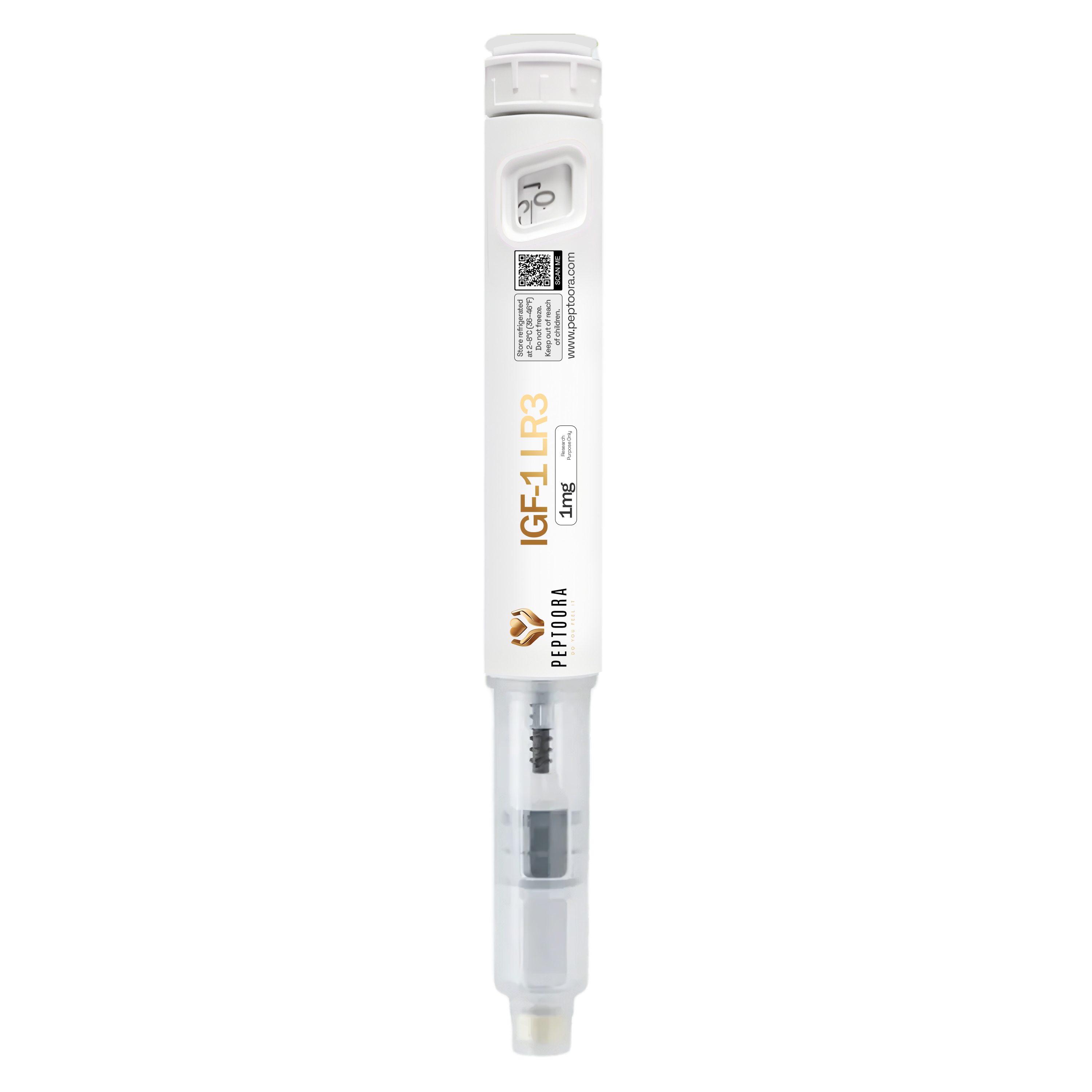
IGF-1LR3 | 1 mg pen
IGF-1LR3 is a peptide positioned for controlled research settings where IGF-1 receptor signaling is being studied in relation to protein synthesis outputs, satellite cell activity, and tissue remodeling endpoints.
Supports
- IGF-1R-driven PI3K/Akt/mTOR signaling readouts (model-dependent)
- Protein synthesis and muscle hypertrophy markers (endpoint-based)
- Satellite cell activation and myogenic differentiation measures
- Cell survival and proliferation signaling outputs (protocol-dependent)
- Recovery-associated tissue remodeling markers (e.g., collagen/ECM endpoints)
Description
IGF-1 LR3 (long arginine-3 IGF-1) is a modified analog of insulin-like growth factor 1 designed to extend biological activity and alter binding interactions with IGF-binding proteins (IGFBPs). In research contexts, LR3 modifications are commonly discussed as increasing the proportion of free, receptor-accessible ligand relative to native IGF-1, enabling prolonged interrogation of IGF-1 receptor (IGF-1R) signaling under controlled experimental conditions.
In mechanistic studies, IGF-1LR3 is used to evaluate how direct IGF-1R activation influences downstream anabolic signaling cascades (notably PI3K/Akt/mTOR and related growth/survival pathways), and how these signals map onto measurable endpoints such as protein synthesis, myogenic differentiation, and tissue remodeling readouts. Because IGF signaling is tightly regulated by IGFBPs and feedback loops in vivo, experimental design often includes careful endpoint selection and monitoring to interpret model-dependent effects.
IGF-1LR3 is positioned strictly for laboratory research use, where results are interpreted within defined models and endpoints rather than as therapeutic outcomes.
Clinical Status
Direct clinical evidence for IGF-1LR3 as a distinct analog is limited and is generally interpreted through preclinical models and the broader clinical literature on recombinant human IGF-1 (mecasermin) and IGF-axis modulation. IGF-1LR3 is not stated as an approved therapy in the provided raw text and remains positioned as investigational for experimental use.
Evidence type:
Human RCT ▣ | Observational ▣ | Animal ✔ | In vitro ✔ | Regulatory approval ☐
Mechanism of Action
IGF-1LR3 activates the IGF-1 receptor (IGF-1R), a receptor tyrosine kinase that initiates phosphorylation cascades regulating growth and survival programs. In experimental systems, IGF-1R activation is commonly tracked via PI3K/Akt signaling and mTOR-associated translation control, alongside MAPK/ERK-linked proliferation signals depending on cell type and context.
Compared with native IGF-1, LR3 modifications are discussed in the literature as reducing IGFBP-mediated sequestration, increasing receptor-accessible ligand in certain model settings. This can extend the temporal window for IGF-1R engagement and downstream endpoint measurement, but also reduces physiologic buffering by IGFBPs—making protocol design, controls, and monitoring central to interpretation.
Benefits
-
Direct activation of the IGF-1 receptor for anabolic signaling:
IGF-1 LR3 binds directly to the IGF-1 receptor expressed on muscle and other peripheral tissues. This receptor functions as a tyrosine kinase that initiates intracellular growth cascades once activated. Unlike growth hormone secretagogues that rely on stimulating the pituitary first, IGF-1 LR3 works downstream at the tissue level. This direct engagement creates a more immediate anabolic signaling response in experimental models. Activation of this receptor influences pathways associated with protein synthesis, cell survival, and structural adaptation. Because the signal originates at the receptor level, it bypasses hypothalamic and pituitary regulatory layers. -
Extended half-life and prolonged receptor engagement:
One of the defining features of IGF-1 LR3 is its structural modification that reduces binding to IGF-binding proteins. In native form, IGF-1 is tightly regulated by these proteins, limiting free circulating activity. The LR3 modification allows more unbound peptide to remain biologically active. This increases duration of receptor interaction and sustains anabolic signaling over a longer period. In research settings, this extended engagement is associated with prolonged intracellular activation compared to native IGF-1. -
Stimulation of the PI3K/Akt/mTOR protein synthesis pathway:
Upon receptor activation, IGF-1 LR3 triggers intracellular cascades including PI3K and Akt phosphorylation. These signals converge on mTOR, a master regulator of protein translation and cellular growth. mTOR activation increases ribosomal activity and enhances structural protein assembly within muscle fibers. This cascade is central to hypertrophy-related research. Because the pathway operates inside the cell, it influences structural remodeling rather than superficial fluid retention or transient effects. -
Promotion of muscle cell differentiation and satellite cell support:
IGF signaling is involved in the activation and differentiation of satellite cells, which are precursor cells responsible for muscle regeneration. In laboratory models, IGF-1 pathway stimulation increases expression of myogenic regulatory factors. These factors coordinate transformation of precursor cells into mature contractile fibers. This cellular process contributes to structural muscle adaptation in controlled experimental settings. -
Influence on cellular survival and anti-apoptotic signaling:
Beyond muscle growth, IGF-1 receptor activation influences survival pathways within cells. Akt signaling promotes anti-apoptotic mechanisms that help protect cells under stress conditions. This dimension extends IGF-1 LR3 relevance beyond hypertrophy into broader tissue resilience research. By supporting cellular survival cascades, it contributes to regenerative signaling environments in experimental models. -
Metabolic signaling integration:
IGF-1 shares structural similarity with insulin and interacts with metabolic signaling networks. Activation of IGF pathways influences glucose uptake, nutrient utilization, and energy partitioning at the cellular level. These effects connect anabolic signaling with metabolic regulation. In research contexts, this integration allows exploration of how growth signaling and nutrient handling intersect. -
Bypasses upstream endocrine stimulation:
Unlike peptides that stimulate growth hormone release, IGF-1 LR3 does not depend on pituitary activation. It directly engages peripheral receptors without first altering hypothalamic pulses. This distinction makes it relevant in research focused specifically on downstream anabolic mechanisms rather than upstream endocrine control. The absence of pituitary stimulation changes its signaling profile compared to GH secretagogues. -
Sustained intracellular growth signaling environment:
Because of its extended activity and direct receptor binding, IGF-1 LR3 creates a more persistent intracellular growth signal in experimental systems. Sustained activation of Akt and MAPK pathways contributes to ongoing protein synthesis and cellular adaptation. This prolonged intracellular environment differentiates it from shorter-acting IGF variants. -
Designed for structured anabolic research use:
Provided in a stabilized pre-mixed injection pen for SubQ administration, IGF-1 LR3 supports predictable systemic exposure in controlled research protocols. Subcutaneous delivery allows structured dosing and reproducible receptor engagement assessment. Each unit is freshly prepared and intended strictly for laboratory use only.
Research Data
| Study/model | Reported effect |
| IGF-1 analog overview (human/clinical monitoring review) | LR3 IGF-1 described as an IGF-1 analog with Arg3 substitution and N-terminal extension; altered IGFBP interaction discussed |
| Fetal sheep infusion of recombinant LR3 IGF-1 (in vivo) | Increased organ growth and skeletal muscle myoblast proliferation reported; reduced IGFBP regulation noted |
| Volumetric muscle loss model using IGF1-LR3 delivery (preclinical) | IGF1-LR3 delivery investigated to enhance muscle recovery endpoints in a tissue engineering framework |
| IGF-1R signaling mechanistic studies (cell models) | PI3K/Akt/mTOR activation downstream of IGF-1R commonly used as pathway readouts for growth/survival signaling |
| IGFBP regulation literature (review) | IGFBPs described as key regulators of IGF bioavailability and receptor access in extracellular environments |
| rhIGF-1/rhIGFBP-3 trial in neuromuscular disease (human) | Lean body mass and metabolic endpoints reported with structured safety monitoring (context for IGF-axis manipulation) |
| Mecasermin (rhIGF-1) clinical review literature (human) | Clinical framework for IGF-1 replacement and monitoring described (context for IGF-1 pathway effects and safety endpoints) |
| IGF-1R-dependent transcriptional programs (cell models) | IGF-1R signaling linked to gene expression and stress-response endpoints in defined experimental systems |
Stack Suggestions
In extended experimental designs, IGF-1LR3 is sometimes paired with:
- CJC-1295 (No-DAC) → upstream GH-axis pulse studies alongside downstream IGF-1R signaling endpoints
- Somatropin (Human Growth Hormone) → comparative GH–IGF axis designs (endocrine vs direct receptor activation)
- BPC-157 → tissue remodeling endpoint exploration in recovery-oriented experimental frameworks
Stacks discussed are for experimental design only, not safety/efficacy guidance.
Possible Side Effects
Potential adverse effects are model- and protocol-dependent, and should be monitored within controlled research settings. Because IGF-axis manipulation can influence glucose handling and fluid balance, studies may track endpoints related to hypoglycemia risk, edema/fluid shifts, headache, and local injection-site reactions. In longer or higher-exposure designs, careful monitoring of growth-signaling–related biomarkers is commonly included to contextualize proliferative pathway engagement.
Scientific References
- Insulin-Like Growth Factor-1 (IGF-1) and Its Monitoring in Clinical and Sports Settings — Review
- Sheep recombinant IGF-1 promotes organ-specific growth outcomes following experimental infusion of an IGF-1 analog (LR3 IGF-1) — Animal
- Provisional Treatment of Volumetric Muscle Loss With IGF1-LR3 Delivery in a Synthetic In Situ Forming Hydrogel — Animal
- Insulin-like growth factor signaling as a therapeutic target: IGF-1R activation and PI3K/Akt pathway — Review
- Insulin-like growth factor 1 receptor signaling stimulates PI3K/AKT/mTOR-linked stress-response programs in cell models — In vitro
- Role of IGF-binding proteins in regulating IGF responses to physiological and pathological stimuli — Review
- Insulin-like growth factor-binding proteins (IGFBPs): roles in IGF bioavailability and ligand-receptor interactions — Review
- An Open-Label Trial of Recombinant Human Insulin-Like Growth Factor-1/IGF Binding Protein-3 in Myotonic Dystrophy Type 1 — Human
- Mecasermin (recombinant human insulin-like growth factor I): clinical overview and monitoring considerations — Review
- Clinical Review: Mecasermin (Increlex) and recombinant human IGF-1 replacement therapy — Review
Cautions
- For educational and scientific context only; not intended to diagnose, treat, cure, or prevent any disease.
- If you are pregnant, nursing, have a medical condition, or use prescription medication, consult a qualified professional.
- Discontinue use if sensitivity occurs.
Pairs well with
In stock!
Complimentary shipping & returns
IGF-1LR3 | 1 mg pen
FAQs
Read our FAQs page to find more
Do I need a prescription to order?
No prescription is required to order. However, we recommend consulting a healthcare professional before starting any injectable therapy.
How should I store my products?
Store unopened products in a cool, dry place. Refrigerate as instructed after opening.
Are the peptide pens pre-mixed?
Yes. Our peptide pens are pre-mixed and ready to use. They are formulated for convenience and consistent dosing without the need for reconstitution.
Are these products suitable for everyone?
These products are intended for responsible adult use. Individual suitability varies depending on medical history, medications, and overall health status. Consulting a qualified medical professional before use is essential.
Are these products intended for medical treatment?
These products are not intended to diagnose, treat, cure, or prevent any disease. They are offered within the scope of applicable regulations and should be used responsibly.
If you have any questions, you are always welcome to contact us. We'll get back to you as soon as possible, within 24 hours on weekdays.
-
Shipping Information
Use this text to answer questions in as much detail as possible for your customers.
-
Customer Support
Use this text to answer questions in as much detail as possible for your customers.
-
FAQ’s
Use this text to answer questions in as much detail as possible for your customers.
-
Contact Us
Use this text to answer questions in as much detail as possible for your customers.