

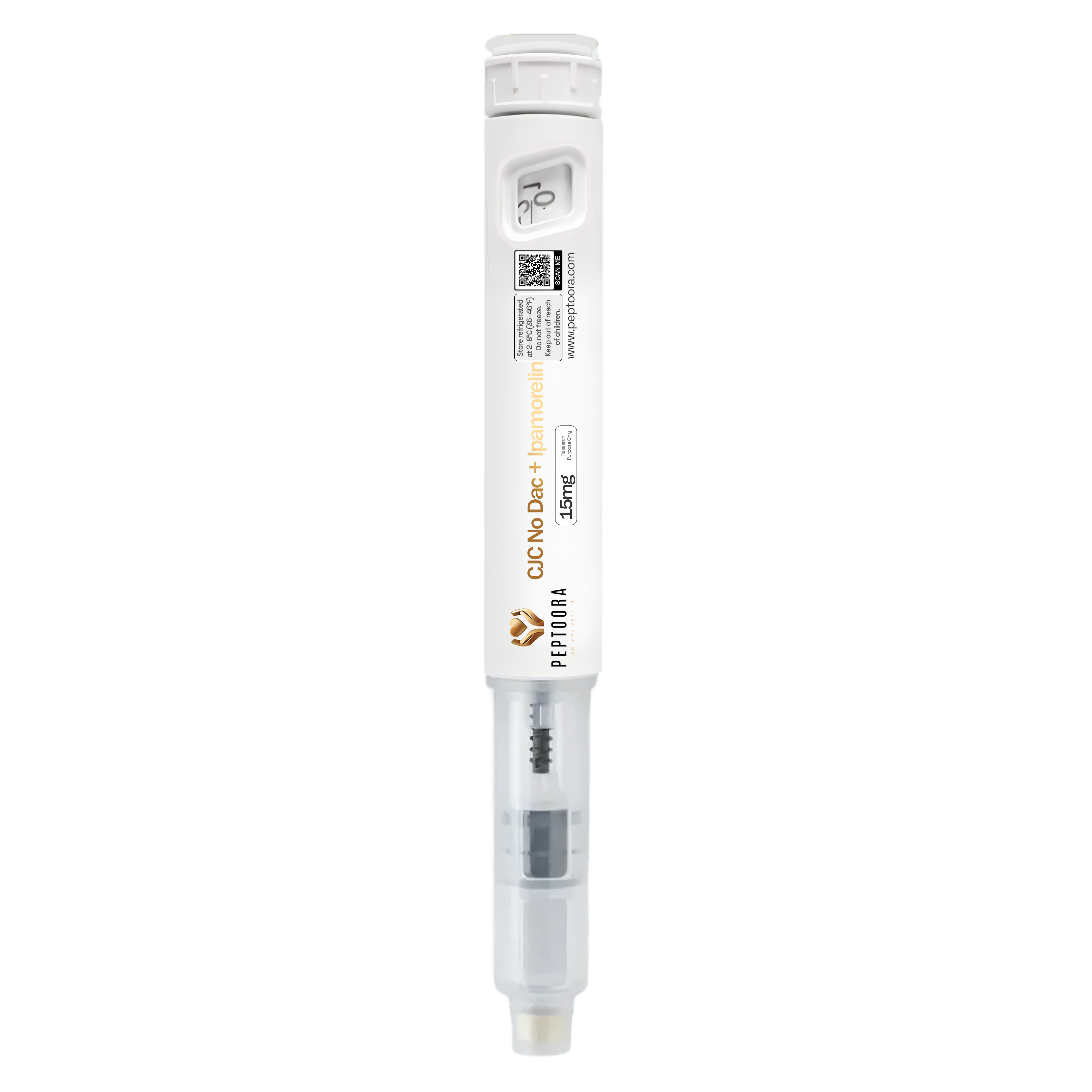
CJC-1295 (No DAC) + Ipamorelin | 15 Mg Pen
CJC-1295 (No-DAC) + Ipamorelin is a blend positioned for controlled research settings where endogenous GH-axis modulation is being studied in relation to pulsatile growth hormone dynamics, IGF-1 axis outputs, and metabolic adaptation endpoints.
Supports
- Physiologic GH pulse amplification (pattern- and timing-dependent)
- Downstream IGF-1 and IGF-binding protein profiles (endpoint-based)
- Pituitary GHRH-receptor signaling readouts (cAMP/PKA-linked)
- Ghrelin receptor (GHS-R1a)–mediated secretagogue signaling (calcium/PKC-linked)
- Body-composition and substrate-utilization endpoints tracked in GH-secretagogue research
Description
CJC-1295 (No-DAC) + Ipamorelin combines two mechanistically distinct GH secretagogue approaches: a short-acting GHRH-analog pathway (CJC-1295 No-DAC) and a selective ghrelin receptor (GHS-R1a) agonist pathway (Ipamorelin). In experimental endocrinology, pairing these mechanisms is used to study whether dual-receptor stimulation can increase GH pulse amplitude while preserving rhythmic features that are central to physiologic GH signaling.
In research designs, CJC-1295 (No-DAC) is commonly positioned as a pulse-aligned stimulus acting at pituitary somatotroph GHRH receptors, while Ipamorelin is used to probe ghrelin-receptor secretagogue signaling with comparatively reduced emphasis on broader neuroendocrine effects described for some earlier GHRP compounds. Together, the blend is investigated through measurable endpoints such as GH pulsatility metrics, IGF-1/IGFBP profiles, and metabolic or recovery-associated readouts where GH–IGF signaling is treated as a study variable.
This product is positioned strictly for laboratory research where endocrine outputs are monitored in controlled protocols and interpreted as model-dependent signals rather than therapeutic outcomes.
Clinical Status
Human research exists for GHRH analogs and GH secretagogues (including long-acting CJC-1295 constructs in controlled trials and ghrelin-receptor agonist programs), with extensive supporting preclinical and in vitro evidence describing receptor biology and downstream signaling. Evidence for a specific fixed-dose combination is typically interpreted through the broader class literature and mechanistic rationale rather than regulatory authorization.
Evidence type:
Human RCT ✔ | Observational ✔ | Animal ✔ | In vitro ✔ | Regulatory approval ☐
Mechanism of Action
CJC-1295 (No-DAC) is studied as a GHRH-receptor agonist at anterior pituitary somatotroph cells. GHRH receptor activation increases adenylate cyclase activity and intracellular cAMP, engaging PKA-linked signaling that supports GH synthesis and release. The “No-DAC” designation is used to emphasize shorter systemic activity relative to albumin-binding (DAC) constructs, supporting timing-focused experiments on pulse architecture.
Ipamorelin is studied as a selective agonist at the ghrelin receptor (GHS-R1a), a GPCR involved in GH secretagogue signaling. In experimental systems, GHS-R1a activation is associated with intracellular calcium mobilization and downstream kinase signaling that can augment GH release. Dual stimulation (GHRH receptor + GHS-R1a) is used in research to examine additive or synergistic effects on GH pulse amplitude and consequent IGF-1 axis outputs, while keeping hypothalamic feedback dynamics measurable within the study design.
Benefits
-
Synergistic Growth Hormone Stimulation:
The combination of CJC-1295 (No-DAC) and Ipamorelin is studied for its synergistic activation of the pituitary growth hormone (GH) axis. CJC-1295 (No-DAC) enhances natural GH-releasing hormone signaling, while Ipamorelin acts as a selective ghrelin receptor agonist. Together, they amplify pulsatile GH secretion, leading to increased IGF-1 levels and broad systemic support for tissue repair, recovery, and metabolism in research models. -
Enhanced Muscle Growth and Recovery:
This peptide pairing has been observed to support lean muscle development through improved nitrogen retention, protein synthesis, and satellite cell activation. The GH-IGF-1 cascade activated by this combination enhances muscle fiber repair and post-exercise recovery, making it highly relevant in regenerative and performance-related studies. -
Improved Sleep and Cellular Regeneration:
Research shows that CJC-1295 + Ipamorelin enhances deep sleep quality by increasing natural GH pulses during the night. These nocturnal GH peaks are associated with accelerated cellular repair, collagen production, and improved recovery capacity — all critical factors for tissue restoration and long-term metabolic health. -
Reduction of Adipose Tissue and Fat Oxidation:
Through its influence on growth hormone signaling, this peptide combination stimulates lipolysis and fatty acid mobilization while inhibiting lipogenesis. This metabolic rebalancing supports reduced body fat levels and improved body composition without altering appetite or blood glucose, highlighting its value in body recomposition and metabolic optimization research. -
Increased Collagen Production and Skin Quality:
The GH-IGF-1 axis stimulated by CJC-1295 + Ipamorelin promotes collagen synthesis and skin elasticity. Studies suggest improved dermal thickness and hydration, positioning this combination as a promising model for research into anti-aging and regenerative dermatology. -
Support for Bone Density and Joint Integrity:
Growth hormone pulses initiated by this combination stimulate osteoblastic activity and calcium retention, improving bone mineral density and supporting joint health. The resulting enhancement of connective tissue integrity makes it a key focus in musculoskeletal regeneration and aging-related bone metabolism research. -
Improved Energy, Mood, and Cognitive Function:
By modulating GH and IGF-1 signaling, this combination has been observed to improve mental clarity, focus, and overall well-being. The enhanced mitochondrial energy production associated with GH stimulation contributes to better vitality, motivation, and cognitive performance under metabolic stress conditions. -
Restoration of Hormonal Rhythm and Homeostasis:
CJC-1295 (No-DAC) + Ipamorelin is studied for its ability to restore natural GH pulsatility that typically declines with age. This restoration supports circadian alignment, balanced endocrine output, and rejuvenated cellular function, providing a physiological approach to age-related hormonal decline models. -
Enhanced Recovery from Injury and Physical Stress:
Through its regenerative effects on muscle, tendon, and joint tissues, this combination enhances healing and recovery rates following physical strain or injury. The GH-mediated increase in collagen formation, cellular proliferation, and angiogenesis contributes to faster restoration of function in experimental recovery settings. -
Improved Metabolic Efficiency and Body Composition:
Studies indicate that GH secretagogues like CJC-1295 and Ipamorelin enhance basal metabolic rate and nutrient utilization. This effect supports improved fat-to-muscle ratio, increased energy levels, and more efficient metabolic activity, making it a promising subject in obesity, longevity, and metabolic optimization research. -
Synergistic Longevity and Anti-Aging Potential:
By sustaining GH-IGF-1 signaling and improving mitochondrial function, this combination supports cellular rejuvenation and longevity pathways. When combined with peptides such as MOTS-c, SS-31, or NAD+, it offers a comprehensive research model for studying anti-aging mechanisms, mitochondrial protection, and energy system preservation.
Research Data
| Study/model | Reported effect |
| Pituitary somatotroph assays (GHRH receptor activation; in vitro) | Increased GH release and cAMP-linked signaling readouts under GHRH-analog stimulation |
| Ghrelin receptor (GHS-R1a) agonist assays (in vitro) | Enhanced secretagogue signaling with calcium-mobilization endpoints and GH release readouts |
| CJC-1295 class trials in healthy adults (randomized, placebo-controlled) | Increased GH and IGF-1 outputs with structured safety monitoring (class reference for GHRH analogs) |
| Pulsatility analyses during GHRH-analog stimulation (human endocrine research) | GH pulses persist under stimulation; pulse architecture can be quantified as a primary endpoint |
| Comparative GHRP/ghrelin-agonist programs (human and preclinical) | Secretagogue effects on GH with protocol-dependent differences across compounds; endocrine markers tracked |
| Neuroendocrine feedback frameworks (hypothalamic–pituitary modeling) | Somatostatin/GHRH balance influences observed GH patterns; feedback-intact interpretation emphasized |
| Metabolic research contexts tracking GH–IGF outputs | Changes in body-composition and metabolic endpoints evaluated alongside GH/IGF markers (population- and protocol-dependent) |
| Combination rationale (dual-receptor experimental design) | Additive GH pulse amplitude effects are hypothesized/assessed by combining upstream (GHRH) and secretagogue (GHS-R1a) routes |
Stack Suggestions
In extended experimental designs, CJC-1295 (No-DAC) + Ipamorelin is sometimes paired with:
- GHK-Cu → Supports skin and connective tissue regeneration
- BPC-157 + TB-500 → Complements recovery and tissue healing
- NAD+ → Enhances mitochondrial energy metabolism and cellular recovery
-
MOTS-c → Synergizes in metabolic optimization protocols
Stacks discussed are for experimental design only, not safety/efficacy guidance.
Possible Side Effects
CJC-1295 (No-DAC) and Ipamorelin are generally observed to be well-tolerated in research, particularly Ipamorelin due to its selectivity in not raising cortisol or prolactin levels. However, as with all peptides, a range of possible side effects may be observed, particularly in the initial stages of administration or with higher doses.
Injection Site Reactions: The most common adverse reactions are typically localized to the administration site. These may include mild pain, redness, irritation, or swelling immediately following the subcutaneous injection. These reactions are usually transient and often decrease with continued administration. Proper rotation of injection sites is a key guideline to minimize this occurrence.
Water Retention (Edema): Increased Growth Hormone (GH) levels can sometimes lead to the body holding onto extra fluid, which may result in temporary bloating or mild swelling in the extremities. This effect is manageable but may be more pronounced in initial weeks.
Headaches or Flushing: Some subjects report mild to moderate headaches, which may be related to fluctuations in GH and blood flow. A warm sensation or flushing of the face and neck is also a reported side effect, often occurring shortly after injection and subsiding within minutes.
Tingling or Numbness (Paresthesia): Changes in GH and IGF-1 can occasionally lead to a sensation of tingling, often in the hands or feet. This symptom is typically mild and is a known effect associated with GH elevation.
Dizziness or Hyperactivity: Less than 1 percent of patients report dizziness or a feeling of mild hyperactivity shortly after administration.
It is important to emphasize that most observed side effects are temporary and mild. Research protocols must include careful monitoring and adherence to recommended dosage to ensure safety and manage any adverse reactions.
Scientific References
- Prolonged stimulation of growth hormone (GH) and insulin-like growth factor I secretion by CJC-1295, a long-acting analog of GH-releasing hormone, in healthy adults — Human RCT
- Pulsatile secretion of growth hormone (GH) persists during continuous stimulation by CJC-1295, a long-acting GHRH analog — Human RCT
- Activation of the GH/IGF-1 axis by CJC-1295, a long-acting GHRH analog, results in serum protein profile changes in normal adult subjects — Human RCT
- Ipamorelin as a selective ghrelin receptor (GHS-R1a) agonist and growth hormone secretagogue (search) — Human/Preclinical
- Ghrelin receptor (GHS-R1a) signaling mechanisms relevant to GH secretagogues (search) — In vitro
- GHRH receptor signaling in pituitary somatotrophs: cAMP/PKA and GH release (search) — In vitro
- GHRH(1–29) (sermorelin) clinical studies assessing GH/IGF-1 axis outputs (search) — Human RCT/Observational
- GH pulsatility, somatostatin/GHRH feedback, and endocrine rhythm models (search) — Review/Human
- CJC-1295 + Ipamorelin: synergy and pharmacodynamic modelling overview (regulatory docket attachment) — Preclinical/Modeling
- CJC-1295 safety profile: subcutaneous administration in early trials (regulatory docket attachment) — Human
- Beyond the androgen receptor: the role of growth hormone secretagogues including ipamorelin Review
- Identification of CJC-1295, a growth-hormone-releasing peptide, in antidoping analyses In vitro
- High sensitivity mass spectrometric quantification of serum growth hormone: implications for GHRH analogs In vitro
- Ipamorelin: selective agonist of the ghrelin/GHS-R-1a receptor and growth hormone secretagogue Review
- CJC-1295 + Ipamorelin combination – FDA regulatory document Regulatory
Cautions
- For educational and scientific context only; not intended to diagnose, treat, cure, or prevent any disease.
- If you are pregnant, nursing, have a medical condition, or use prescription medication, consult a qualified professional.
- Discontinue use if sensitivity occurs.
Pairs well with
In stock!
Complimentary shipping & returns
CJC-1295 (No DAC) + Ipamorelin | 15 Mg Pen
FAQs
Read our FAQs page to find more
Do I need a prescription to order?
No prescription is required to order. However, we recommend consulting a healthcare professional before starting any injectable therapy.
How should I store my products?
Store unopened products in a cool, dry place. Refrigerate as instructed after opening.
Are the peptide pens pre-mixed?
Yes. Our peptide pens are pre-mixed and ready to use. They are formulated for convenience and consistent dosing without the need for reconstitution.
Are these products suitable for everyone?
These products are intended for responsible adult use. Individual suitability varies depending on medical history, medications, and overall health status. Consulting a qualified medical professional before use is essential.
Are these products intended for medical treatment?
These products are not intended to diagnose, treat, cure, or prevent any disease. They are offered within the scope of applicable regulations and should be used responsibly.
If you have any questions, you are always welcome to contact us. We'll get back to you as soon as possible, within 24 hours on weekdays.
-
Shipping Information
Use this text to answer questions in as much detail as possible for your customers.
-
Customer Support
Use this text to answer questions in as much detail as possible for your customers.
-
FAQ’s
Use this text to answer questions in as much detail as possible for your customers.
-
Contact Us
Use this text to answer questions in as much detail as possible for your customers.