

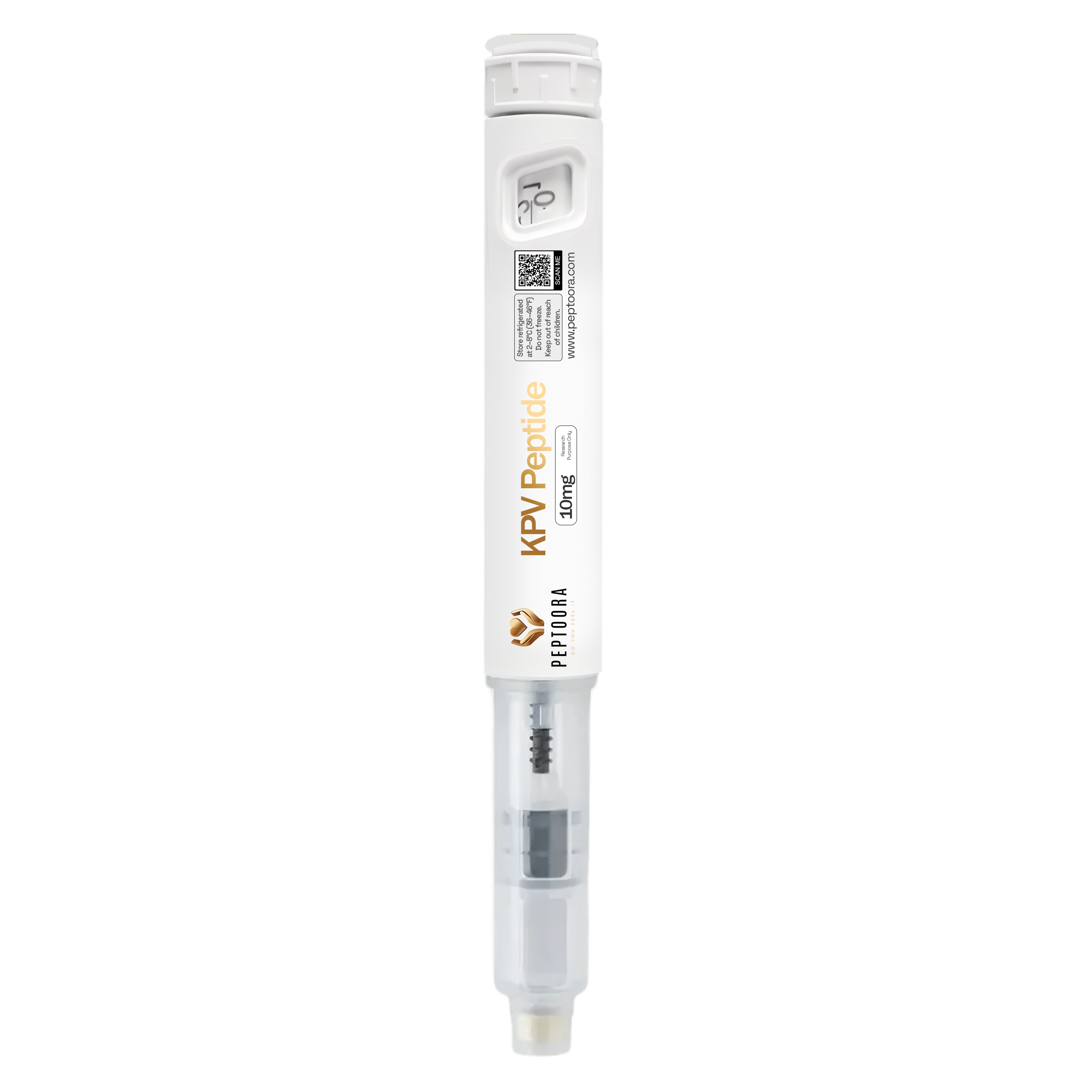
KPV Peptide | 15 mg pen
KPV (Lys-Pro-Val) is a peptide positioned for controlled research settings where cytokine regulation and inflammatory signaling control is being studied in relation to NF-κB activity, pro-inflammatory cytokine output, and epithelial barrier integrity.
Supports
- NF-κB–linked inflammatory signaling control (model-dependent)
- Balanced cytokine messenger profiles (TNF-α/IL-6/IL-8 endpoints)
- Epithelial barrier resilience and permeability readouts
- Localized immune-cell recruitment and chemokine signaling dynamics
- Inflammation resolution trajectories in tissue-stress models
Description
KPV (Lys-Pro-Val) is a C-terminal tripeptide sequence derived from α-melanocyte-stimulating hormone (α-MSH) that has been investigated as a focused anti-inflammatory signaling fragment in preclinical systems. Unlike full melanocortin agonists, KPV is frequently described in the literature as showing anti-inflammatory effects that can occur with minimal or no broad melanocortin receptor activation, depending on model and assay conditions.
Across experimental designs, KPV has been studied for its relationships to cytokine modulation and transcriptional signaling control, including reported inhibition of NF-κB–associated pathways and downstream cytokine expression. Research attention often centers on epithelial tissues (e.g., intestinal or airway epithelium) where barrier function, chemokine gradients, and immune recruitment can be quantified under inflammatory challenge.
In gastrointestinal research contexts, KPV has also been explored in connection with peptide transport mechanisms (such as PepT1/PEPT1) and how epithelial uptake may relate to local anti-inflammatory effects and barrier outcomes. All findings are model-dependent and should be interpreted within controlled laboratory settings.
Clinical Status
KPV is primarily characterized in mechanistic and preclinical research (cellular systems and animal models) evaluating inflammatory signaling, cytokine patterns, and epithelial barrier endpoints. Human clinical evidence is limited and not established as routine clinical practice outcomes.
Evidence type:
Human RCT ▣ | Observational ▣ | Animal ▣ | In vitro ✔ | Regulatory approval ☐
Mechanism of Action
KPV is commonly described as a minimal α-MSH–derived sequence capable of modulating inflammatory signaling cascades, including reported reductions in NF-κB activation and downstream pro-inflammatory mediator expression in certain experimental systems. In some contexts, KPV and related melanocortin fragments are discussed as influencing IL-1–linked signaling and broader cytokine networks without the full spectrum of melanocortin agonist effects.
In epithelial-focused models, KPV has been investigated for transporter-linked uptake (notably PepT1/PEPT1 in intestinal systems) and for downstream effects on chemokine release, immune-cell recruitment signals, and barrier integrity measures. Mechanistic conclusions vary by model, cell type, dosing design, and inflammatory trigger, so pathway attribution should remain assay-specific.
Benefits
-
Helps calm overactive inflammatory responses:
KPV is studied for its ability to help regulate inflammatory signaling when the immune system becomes overly reactive. Instead of shutting down immune activity completely, it appears to support a more balanced response. This is important because excessive inflammation can disrupt normal tissue function. In laboratory models, KPV has been associated with reduced levels of certain pro-inflammatory messengers. The goal of this signaling shift is not immune suppression, but improved regulation. This makes KPV relevant in research focused on chronic or localized inflammation. -
Supports gut lining integrity and barrier stability:
The intestinal barrier plays a critical role in separating the external environment from internal immune signaling. When this barrier becomes compromised, inflammatory processes can escalate. KPV has been studied in experimental gut inflammation models where improved epithelial stability was observed. Research suggests it may influence tight junction proteins that help maintain structural integrity of the gut lining. By supporting barrier resilience, KPV is often explored in gastrointestinal research contexts. -
Encourages balanced cytokine signaling:
Cytokines are chemical messengers that control immune communication. When certain cytokines are overproduced, inflammatory cycles can become self-sustaining. KPV has been evaluated for its influence on regulating key inflammatory mediators. Rather than eliminating these signals, it appears to help moderate their intensity. This fine-tuning approach supports immune balance instead of blunt suppression. -
Studied in inflammatory skin models:
Inflammation is not limited to internal tissues; the skin is also a highly active immune organ. KPV has been explored in dermatologic research models involving inflammatory signaling in keratinocytes. Reduced inflammatory marker expression has been observed in controlled laboratory settings. This expands its relevance beyond gastrointestinal research into broader epithelial biology. -
Promotes a more controlled immune environment:
A healthy immune response requires precision. Too little activation increases vulnerability, while too much can damage tissue. KPV is studied for its role in helping maintain this balance. Its effects appear localized and regulatory rather than system-wide suppression. This makes it an interesting candidate in research examining immune recalibration rather than immune shutdown. -
Derived from a natural anti-inflammatory sequence:
KPV originates from the alpha-MSH peptide, which is naturally involved in anti-inflammatory signaling in the body. As a small fragment, it retains certain regulatory properties without activating the entire melanocortin system. This selective behavior allows researchers to study focused inflammatory modulation without broader hormonal effects. -
Explored in models of chronic low-grade inflammation:
Chronic low-level inflammation is increasingly studied in metabolic and barrier-related conditions. KPV has been evaluated in experimental systems that simulate prolonged inflammatory stress. Findings suggest it may help reduce excessive immune signaling in these contexts. Its small size and targeted activity profile support investigation in localized inflammatory environments. -
Designed for structured research use:
Provided in a stabilized pre-mixed injection pen for SubQ administration, KPV supports controlled experimental exposure. Subcutaneous delivery allows consistent absorption in research protocols. Each unit is freshly prepared and intended strictly for laboratory use only.
Research Data
| Study/model | Reported effect |
| Human intestinal epithelial cell systems (PepT1/PEPT1-linked uptake) | Reported reductions in inflammatory signaling and cytokine outputs with transporter-dependent features in certain designs |
| Experimental colitis models (murine; chemically induced inflammation) | Reported improvements in inflammatory indices and barrier-related outcomes (model-dependent) |
| Airway epithelial inflammation models (human bronchial epithelial cells) | Reported suppression of chemokine signaling linked to inflammatory cell recruitment in vitro |
| Crystal-induced peritonitis (animal inflammation model) | Reported anti-inflammatory effects of α-MSH(11–13)/KPV compared with other melanocortin fragments |
| Microglial inflammatory stimulation models (LPS-triggered; cell culture) | Reported decreases in pro-inflammatory mediators (e.g., TNF-α/IL-6/NO endpoints) in specific systems |
| Alveolar/airway epithelium inflammatory signaling assays | Reported attenuation of NF-κB translocation/activation under endotoxin challenge in specific models |
| PepT1-linked colitis-associated cancer models (murine) | Reported prevention of inflammation-associated tumorigenesis features in PepT1-competent settings |
| Keratinocyte signaling studies (human skin cell systems) | Reported intracellular signaling effects for melanocortin peptides including KPV, supporting epithelial inflammation research contexts |
Stack Suggestions
In extended experimental designs, KPV (Lys-Pro-Val) is sometimes paired with:
- BPC-157 → to co-study barrier integrity and tissue-stress readouts in parallel models
- LL-37 → to explore epithelial innate defense signals alongside inflammatory mediator endpoints
- Glutathione (reduced) → to test redox-inflammation coupling in oxidative stress co-models
Stacks discussed are for experimental design only, not safety/efficacy guidance.
Possible Side Effects
Human safety data for KPV are limited. In research literature, interpretations are largely based on in vitro and animal findings; tolerance and adverse effects can vary by model, route, formulation, and exposure level. Experimental considerations may include local irritation responses in injection or exposure models, hypersensitivity signals in susceptible systems, and unintended shifts in immune signaling if inflammatory pathways are strongly perturbed. Any observed pigmentation-related effects are generally discussed as minimal compared with full α-MSH activity, but outcomes remain model-dependent.
Scientific References
- PepT1-Mediated Tripeptide KPV Uptake Reduces Intestinal Inflammation — In vitro/Animal
- Mechanism of KPV Action and a Role for MC3R Agonists in Human Airway Epithelium — In vitro
- α-MSH Related Peptides: A New Class of Anti-Inflammatory and Immunomodulatory Agents — Review
- Single Administration of Tripeptide α-MSH(11–13) (KPV) Attenuates Inflammatory Responses in Experimental Models — Animal/In vitro
- Critical Role of PepT1 in Promoting Colitis-Associated Cancer and the Protective Effect of Anti-Inflammatory Tripeptide KPV — Animal
- Dissection of the Anti-Inflammatory Effect of the Core and C-Terminal Peptides of α-MSH: Comparison of α-MSH(11–13) (KPV) in an Inflammation Model — Animal
- Alpha-Melanocyte-Related Tripeptide (KDPV/KPV Analogue) Ameliorates Endotoxin-Induced NF-κB Translocation and Activation in Epithelium — In vitro
- α-MSH, MSH(11–13) KPV and Related Peptides: Intracellular Signalling in Human Keratinocytes — In vitro
- The Melanocortin System in Inflammatory Bowel Diseases — Review
- Curbing Inflammation through Endogenous Pathways: Melanocortins and Pro-Resolution Signaling — Review
Cautions
- For educational and scientific context only; not intended to diagnose, treat, cure, or prevent any disease.
- If you are pregnant, nursing, have a medical condition, or use prescription medication, consult a qualified professional.
- Discontinue use if sensitivity occurs.
Pairs well with
In stock!
Complimentary shipping & returns
KPV Peptide | 15 mg pen
FAQs
Read our FAQs page to find more
Do I need a prescription to order?
No prescription is required to order. However, we recommend consulting a healthcare professional before starting any injectable therapy.
How should I store my products?
Store unopened products in a cool, dry place. Refrigerate as instructed after opening.
Are the peptide pens pre-mixed?
Yes. Our peptide pens are pre-mixed and ready to use. They are formulated for convenience and consistent dosing without the need for reconstitution.
Are these products suitable for everyone?
These products are intended for responsible adult use. Individual suitability varies depending on medical history, medications, and overall health status. Consulting a qualified medical professional before use is essential.
Are these products intended for medical treatment?
These products are not intended to diagnose, treat, cure, or prevent any disease. They are offered within the scope of applicable regulations and should be used responsibly.
If you have any questions, you are always welcome to contact us. We'll get back to you as soon as possible, within 24 hours on weekdays.
-
Shipping Information
Use this text to answer questions in as much detail as possible for your customers.
-
Customer Support
Use this text to answer questions in as much detail as possible for your customers.
-
FAQ’s
Use this text to answer questions in as much detail as possible for your customers.
-
Contact Us
Use this text to answer questions in as much detail as possible for your customers.