

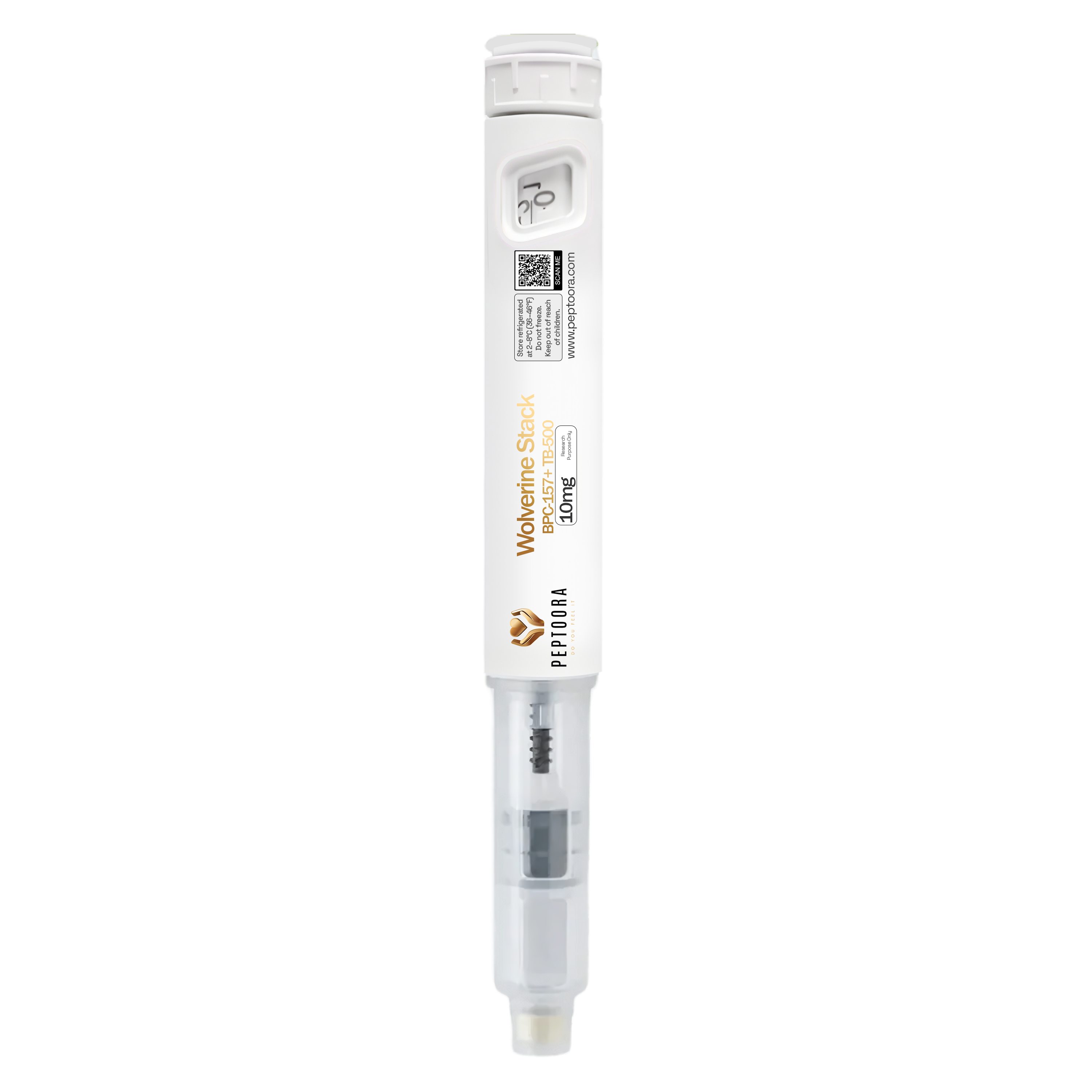
Wolverine Stack (TB-500 & BPC-157) | 15 Mg Pen
BPC-157 & TB-500 is a combined peptide stack positioned for research settings focused on tissue integrity, recovery dynamics, and inflammatory balance. BPC-157 (a gastric-derived pentadecapeptide) and TB-500 (a thymosin beta-4 fragment) are frequently studied in preclinical models for their complementary roles in cellular migration, angiogenic signaling context, and extracellular matrix remodeling.
Supports
- Tissue remodeling processes associated with fibroblast activity and extracellular matrix turnover.
- Angiogenesis-related signaling context linked to microcirculatory support in models.
- Connective tissue resilience frameworks involving collagen organization and structural integrity.
- Inflammatory balance associated with cytokine and oxidative-stress response pathways.
- Recovery-oriented bioadaptation in experimental injury and load-response models.
Description
BPC-157 (Body Protection Compound-157) is a pentadecapeptide originally identified in gastric juice and widely explored in preclinical research related to soft-tissue repair, tendon/ligament integrity, and mucosal resilience. In experimental systems, it has been associated with modulation of growth-factor signaling, fibroblast recruitment, and local perfusion dynamics—processes relevant to tissue remodeling after mechanical or inflammatory stress.
TB-500 is commonly described as a thymosin beta-4 fragment studied for its relationship to actin-associated cellular motility, migration, and angiogenic response in models. These cellular behaviors are core components of repair cascades, where coordinated movement of cells and matrix reorganization influence the quality and pace of tissue remodeling.
When used together in experimental design, BPC-157 is typically positioned for local tissue-support signaling and inflammatory balance context, while TB-500 is positioned for cytoskeletal/migration dynamics and vascular-response context. The combination is therefore studied as a complementary pairing for multi-process recovery frameworks in controlled research settings.
Clinical Status
BPC-157 and TB-500 are research peptides predominantly investigated in preclinical and in vitro models. They are not presented here as approved therapeutic products, and reported observations can vary substantially by model, administration parameters, and study design.
Evidence type:
Human RCT ☐ | Observational ✔ | Animal ✔ | In vitro ✔ | Regulatory approval ☐
Mechanism of Action
In experimental models, BPC-157 has been associated with signaling patterns linked to VEGF-related angiogenic context, fibroblast migration, and nitric-oxide pathway modulation—mechanisms often discussed in relation to perfusion and repair cascades. TB-500 is commonly linked to actin-binding and cytoskeletal dynamics that support cell migration and tissue remodeling in injury-response contexts.
As a combined stack, the peptides are studied for complementary activity across vascular-response signaling, cellular motility, and extracellular matrix organization. These mechanisms are frequently used to frame research hypotheses around recovery kinetics and the structural quality of remodeled tissue under controlled conditions.
Benefits
-
Complementary tissue-repair signaling context:
In preclinical research, the pairing is commonly framed around multi-process recovery—linking fibroblast-associated remodeling with migration-driven repair cascades. Observations are model-dependent and should be interpreted within controlled study design. -
Angiogenesis and microcirculation frameworks:
Both peptides are frequently discussed in connection with angiogenic signaling and microvascular adaptation, which may influence oxygen/nutrient delivery in tissue-repair models. Reported effects vary by injury model and endpoints. -
Inflammatory balance and oxidative-load context:
Experimental literature often describes shifts in cytokine-related and oxidative-stress markers in injury settings, positioning the stack within inflammation-modulation hypotheses rather than therapeutic claims. -
Connective tissue integrity focus:
In tendon and ligament models, reported observations commonly reference collagen organization, matrix turnover, and structural endpoints such as tensile properties—interpreted as research signals for tissue integrity frameworks. -
Muscle recovery and load-response models:
Studies frequently explore muscle contusion or strain paradigms where repair kinetics, edema markers, and functional recovery endpoints are tracked. Findings are dependent on model selection and protocol variables. -
Wound-closure and skin remodeling models:
In cutaneous injury models, literature commonly reports on re-epithelialization dynamics, capillary density markers, and remodeling quality. These findings inform experimental design in tissue regeneration research. -
Neuronal outgrowth and peripheral recovery contexts:
Some preclinical work discusses axonal sprouting, neuromuscular coordination endpoints, or neurotrophic signaling context; interpretation should remain model-specific and non-therapeutic. -
System-wide recovery hypotheses:
The stack is sometimes included in broader experimental recovery frameworks that examine vascular-response signaling and tissue-specific resilience across multiple organs in models.
Research Data
| Study/model | Reported effect |
| Rat Achilles tendon transection |
Faster collagen fiber alignment and fibroblast proliferation by day 7-10; tensile strength ~30-40% higher vs control.
|
| Rodent medial collateral ligament injury |
Improved ligament histology and biomechanical strength; reduced scar tissue density vs saline.
|
| Skeletal muscle contusion (mouse) |
Earlier myofiber regeneration with denser cross-linking and smaller necrotic zones by day 14.
|
| Full-thickness skin wound (rodent) |
↑ capillary density and re-epithelialization rate; combined use outperforms single-peptide arms.
|
| Angiogenesis assays (preclinical) |
TB-500 ↑ VEGF signaling and endothelial migration; BPC-157 stabilizes vasculature → net ↑ perfusion.
|
| Inflammation models (cell/rodent) |
↓ TNF-α, IL-6 and oxidative stress markers; pro-repair cytokine profile supports tissue remodeling.
|
| Tendon fibroblast and ECM markers (in vitro) |
↑ fibroblast migration and collagen I/III organization; improved FAK-paxillin pathway signaling.
|
| Peripheral nerve crush (rodent) |
Trends toward faster functional recovery and axonal sprouting alongside improved local perfusion.
|
| GI mucosal injury (rodent) |
BPC-157 contributes gut barrier protection; pairing with TB-500 maintains microcirculatory flow.
|
| Overuse/strain models (rodent) |
Reduced time to functional recovery and lower edema scores; supports maintenance protocols.
|
Stack Suggestions
BPC-157 & TB-500 is commonly combined with:
- GHK-Cu (collagen and connective-tissue signaling context)
- SS-31 (mitochondrial stress and redox frameworks)
- Epitalon (longevity-model research context)
Stacks discussed are for experimental design only, not safety/efficacy guidance.
Possible Side Effects
In controlled research settings, BPC-157 and TB-500 have been associated with mild, transient tolerability issues in some models, most commonly localized responses following administration. Individual responses can vary, and monitoring is recommended in structured protocols.
Injection-site sensitivity: Temporary redness, swelling, or discomfort has been reported in some settings.
Nausea or GI discomfort: Occasional reports, potentially influenced by model conditions and administration parameters.
Headache or lightheadedness: Sometimes noted early in protocols; typically, transient in anecdotal reports.
Fatigue: Short-lived changes in perceived energy have been reported in some settings.
These notes are not exhaustive and are provided for general context only; they do not constitute medical guidance.
Scientific References
- Gastric pentadecapeptide BPC 157 accelerates healing of transected rat Achilles tendon — Animal
- Pentadecapeptide BPC 157 cream improves burn-wound healing — Animal
- Thymosin β4: a multi-functional regenerative peptide — Animal
- Pharmacokinetics, distribution, metabolism, and excretion of body protective compound-157 — Animal
- Emerging use of BPC-157 in orthopaedic sports medicine — Observational
Cautions
- For educational and scientific context only; not intended to diagnose, treat, cure, or prevent any disease.
- If you are pregnant, nursing, have a medical condition, or use prescription medication, consult a qualified professional.
- Discontinue use if sensitivity occurs.
Pairs well with
In stock!
Complimentary shipping & returns
Wolverine Stack (TB-500 & BPC-157) | 15 Mg Pen
FAQs
Read our FAQs page to find more
Do I need a prescription to order?
No prescription is required to order. However, we recommend consulting a healthcare professional before starting any injectable therapy.
How should I store my products?
Store unopened products in a cool, dry place. Refrigerate as instructed after opening.
Are the peptide pens pre-mixed?
Yes. Our peptide pens are pre-mixed and ready to use. They are formulated for convenience and consistent dosing without the need for reconstitution.
Are these products suitable for everyone?
These products are intended for responsible adult use. Individual suitability varies depending on medical history, medications, and overall health status. Consulting a qualified medical professional before use is essential.
Are these products intended for medical treatment?
These products are not intended to diagnose, treat, cure, or prevent any disease. They are offered within the scope of applicable regulations and should be used responsibly.
If you have any questions, you are always welcome to contact us. We'll get back to you as soon as possible, within 24 hours on weekdays.
-
Shipping Information
Use this text to answer questions in as much detail as possible for your customers.
-
Customer Support
Use this text to answer questions in as much detail as possible for your customers.
-
FAQ’s
Use this text to answer questions in as much detail as possible for your customers.
-
Contact Us
Use this text to answer questions in as much detail as possible for your customers.