

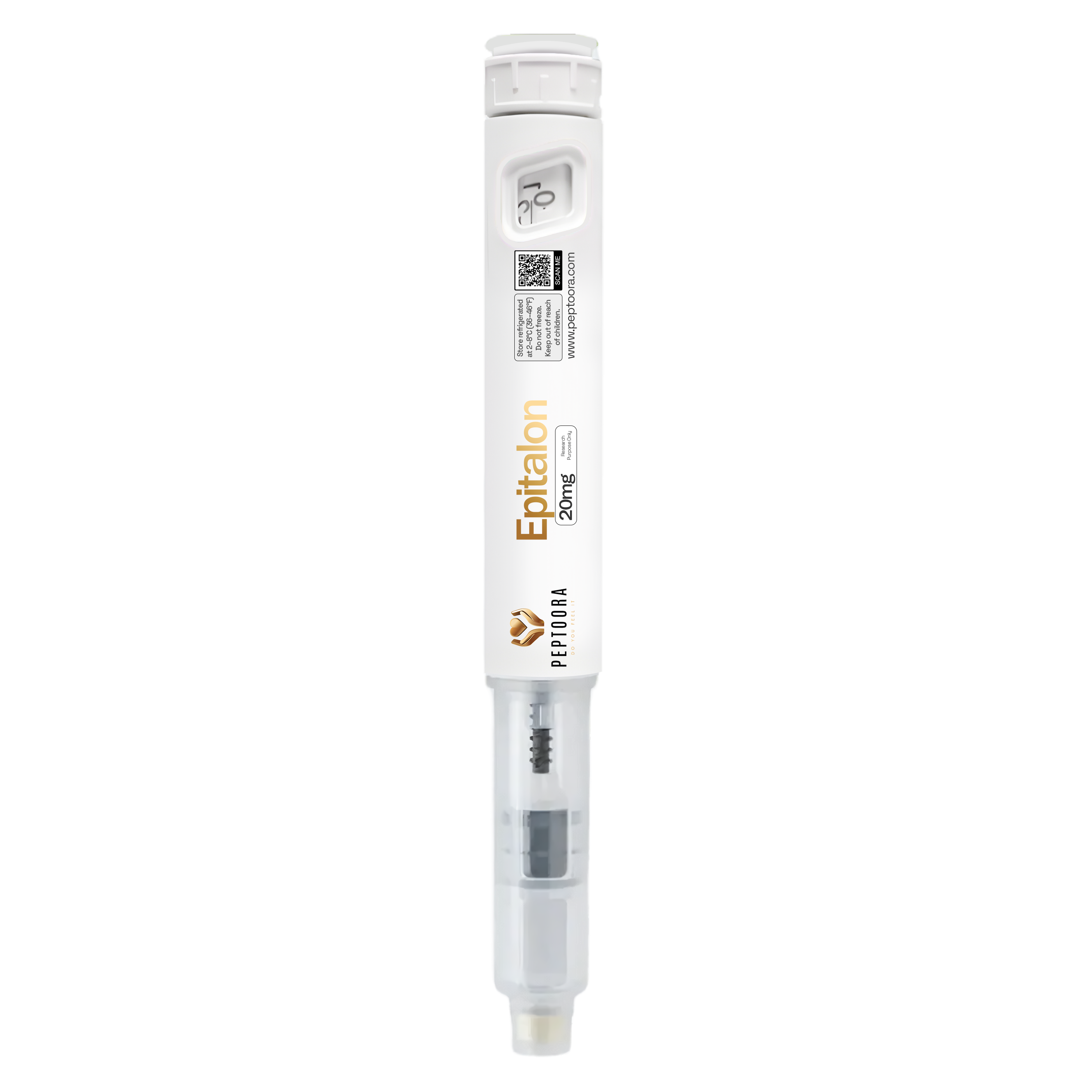
Epithalon | 30 Mg Pen
Epithalon (also referenced as Epitalon) is a synthetic tetrapeptide commonly discussed in longevity research for its association with telomere biology and cellular aging models. Originating from epithalamin-related research, it is explored in controlled settings for potential links to telomerase activity, genomic-stability context, and neuroendocrine (pineal/circadian) signaling frameworks.
Supports
- Telomere biology research frameworks associated with telomerase-activity signaling context.
- Genomic stability context linked to chromosomal end-protection mechanisms in models.
- Cellular aging and senescence research readouts tracked in replicative systems.
- Circadian and pineal signaling frameworks associated with melatonin-related model endpoints.
- Cellular stress-response context monitored through oxidative-load and resilience markers.
Description
Epithalon is a short synthetic tetrapeptide with the sequence Ala–Glu–Asp–Gly. It emerged from research programs examining epithalamin, a pineal-gland extract studied in aging biology, and it is frequently positioned within experimental work focused on telomere dynamics and cellular replication limits. In dividing cells, telomeres serve as protective chromosome-end structures that typically shorten with each replication cycle, and telomerase is the enzyme complex associated with telomere maintenance in certain contexts.
In preclinical and exploratory human research contexts, Epithalon has been investigated for its relationship to telomere-associated markers and broader aging-biology endpoints, including senescence-related signaling patterns and circadian-regulation frameworks. Because pineal signaling and melatonin rhythms are often studied alongside age-associated physiological changes, Epithalon is also referenced in neuroendocrine aging research models.
Epithalon is presented here for controlled research and educational context only. It is not marketed as an approved therapeutic product, and reported observations may differ substantially by model, endpoints, and study design.
Clinical Status
Epithalon is studied primarily in preclinical and in vitro settings, with limited exploratory human data referenced in certain research contexts. It is not presented here as an approved therapeutic product, and interpretation should remain model-specific and endpoint-driven.
Evidence type:
Human RCT ☐ | Observational ☐ | Animal ✔ | In vitro ✔ | Regulatory approval ☐
Mechanism of Action
Epithalon is commonly explored for its potential association with telomerase-activity signaling context and downstream telomere-related readouts in replicative cell models. Because telomere shortening is linked to the onset of replicative senescence in many systems, telomerase-focused hypotheses often examine whether telomere-maintenance markers shift alongside age-associated signaling patterns under controlled conditions.
Research discussions also place Epithalon within pineal/circadian frameworks, where neuroendocrine signaling and melatonin-related endpoints are monitored in parallel with cellular aging markers. Observed effects, where reported, are highly dependent on model selection and experimental design.
Benefits
-
Investigated for telomerase activation and telomere maintenance:
Telomeres shorten progressively with each cell division, eventually contributing to replicative senescence. Epithalon has been studied for its potential to increase telomerase activity, the enzyme responsible for extending telomeric DNA sequences. In laboratory models, activation of telomerase is associated with delayed cellular aging markers. By influencing this enzymatic pathway, Epithalon is positioned within telomere biology research. -
Supports genomic stability research:
Telomere shortening can lead to chromosomal instability and altered gene expression. Maintaining telomere length is associated with preservation of genomic integrity in experimental systems. Epithalon is explored for its influence on chromosomal end protection mechanisms, contributing to investigation of cellular stability pathways. -
Engages cellular senescence pathways:
Cellular senescence is characterized by growth arrest and altered gene expression. Telomerase modulation may influence the timing of senescence onset in dividing cells. Epithalon is studied within models examining how telomere dynamics interact with aging-associated signaling networks. -
Influences pineal gland and circadian regulation research:
Epithalon originates from research on epithalamin, associated with pineal gland activity. The pineal gland regulates melatonin secretion and circadian rhythms. Modulation of pineal-related signaling pathways connects Epithalon to neuroendocrine aging research domains. -
Examined in oxidative stress response models:
Oxidative stress contributes to telomere shortening and cellular damage. Experimental systems investigating Epithalon often evaluate oxidative stress markers alongside telomere dynamics. This positions the peptide within broader cellular resilience research frameworks. -
Studied in replicative lifespan models:
By influencing telomerase activity, Epithalon has been examined in cellular models assessing replicative potential. Increased replicative capacity is linked to extended cellular lifespan in controlled laboratory conditions. These findings support its inclusion in experimental longevity research discussions. -
Targets aging biology at the chromosomal level:
Unlike hormonal peptides that act on membrane receptors, Epithalon operates at the genomic regulation level. Its focus on telomere biology differentiates it from endocrine modulators. This molecular positioning places it within high-level aging research rather than metabolic or anabolic categories. -
Supports integrated longevity pathway investigation:
Aging is influenced by interconnected processes including telomere shortening, oxidative stress, and circadian disruption. Epithalon is studied as a multi-pathway modulator within this framework. Its role in telomere and pineal research integrates genomic and neuroendocrine perspectives in experimental aging models.
Research Data
| Study/model | Reported effect |
| Human somatic cell study (in vitro) | Reported induction of telomerase activity with associated telomere-length readouts in cultured human cells (model- and assay-dependent). |
| Human cell lines (in vitro) — telomere biology | Reported increases in telomere-length measurements in human cell lines, discussed in the context of telomerase upregulation and/or ALT-related mechanisms (interpretation depends on methods used). |
| High-glucose–injured human retinal pigment epithelial cells (in vitro) | Reported improvements in wound-healing–related cellular behaviors under high-glucose injury conditions, framed as antioxidant/stress-response support in a controlled cell model. |
| Non-human primate aging model (monkeys) | Reported shifts in age-associated metabolic markers and melatonin-related endpoints following pineal peptide interventions in an animal aging context (study-specific outcomes). |
| Rodent circadian/monoamine dynamics studies | Reported changes in diurnal dynamics of monoamines and circadian-related readouts in rat models when pineal peptides (including epitalon/epithalamin contexts) were studied alongside melatonin pathways. |
| Review / synthesis papers on AEDG (Epitalon) | Summarize reported findings across telomere biology, pineal/circadian signaling contexts, and aging-model endpoints; emphasize that effects vary by model, dosing window, and study design. |
| Book chapter / review on telomerase & telomere length | Discusses Epitalon-related telomerase activity and telomere-length readouts as presented in the literature, framing use within telomere biology research rather than therapeutic claims. |
Stack Suggestions
In extended experimental designs, Epithalon is sometimes paired with:
- NAD+ (redox and mitochondrial-context frameworks commonly monitored in longevity study designs)
- GHK-Cu (dermal/ECM and antioxidant-context frameworks in repair and aging models)
- Melatonin-focused research frameworks (circadian endpoints where applicable)
Stacks discussed are for experimental design only, not safety/efficacy guidance.
Possible Side Effects
In research contexts, reported tolerability notes for short peptides like Epithalon are generally limited and model-dependent. Where administered, observations may include localized sensitivity at the administration site or transient systemic effects. These notes are provided for general context only; they do not constitute medical guidance.
Injection-site sensitivity: Temporary redness, swelling, or discomfort has been reported in some settings.
Headache or fatigue: Transient changes in perceived energy have been noted anecdotally in certain protocols.
Sleep-pattern changes: Circadian-related endpoints are sometimes monitored; individual responses may vary.
Scientific References
- Epithalon (tetrapeptide) and telomerase-related literature search — PubMed query
- Epitalon and telomere/aging literature search — PubMed query
- Epithalamin, pineal signaling, and aging literature search — PubMed query
- Epithalon peptide induces telomerase activity and telomere elongation in human somatic cells — Human cell study (in vitro)
- Overview of Epitalon—Highly Bioactive Pineal Tetrapeptide (AEDG) in Aging and Longevity Research — Review
- Overview of Epitalon—Highly Bioactive Pineal Tetrapeptide (AEDG) in Aging and Longevity Research — Full-text review (PMC)
- Epitalon increases telomere length in human cell lines through telomerase upregulation or ALT activity — In vitro (human cell lines)
- The Antioxidant Tetrapeptide Epitalon Enhances Delayed Wound Healing in High Glucose–Injured Human Retinal Pigment Epithelial Cells — In vitro
- Pineal peptides restore age-related disturbances in carbohydrate metabolism and melatonin levels in old monkeys — Animal study
- Melatonin and pineal gland peptides (epithalamine and epitalon) correct disturbed diurnal dynamics of monoamines in rats — Animal study
- Effects of melatonin and epiphysis peptides on the diurnal dynamics of monoamines in rats — Animal study
- Effect of Epitalon on Telomerase Activity and Telomere Length — Book chapter / review
- Correction: Epitalon increases telomere length in human cell lines through telomerase upregulation or ALT activity — Journal notice (Biogerontology)
Cautions
- For educational and scientific context only; not intended to diagnose, treat, cure, or prevent any disease.
- If you are pregnant, nursing, have a medical condition, or use prescription medication, consult a qualified professional.
- Discontinue use if sensitivity occurs.
Pairs well with
In stock!
Complimentary shipping & returns
Epithalon | 30 Mg Pen
FAQs
Read our FAQs page to find more
Do I need a prescription to order?
No prescription is required to order. However, we recommend consulting a healthcare professional before starting any injectable therapy.
How should I store my products?
Store unopened products in a cool, dry place. Refrigerate as instructed after opening.
Are the peptide pens pre-mixed?
Yes. Our peptide pens are pre-mixed and ready to use. They are formulated for convenience and consistent dosing without the need for reconstitution.
Are these products suitable for everyone?
These products are intended for responsible adult use. Individual suitability varies depending on medical history, medications, and overall health status. Consulting a qualified medical professional before use is essential.
Are these products intended for medical treatment?
These products are not intended to diagnose, treat, cure, or prevent any disease. They are offered within the scope of applicable regulations and should be used responsibly.
If you have any questions, you are always welcome to contact us. We'll get back to you as soon as possible, within 24 hours on weekdays.
-
Shipping Information
Use this text to answer questions in as much detail as possible for your customers.
-
Customer Support
Use this text to answer questions in as much detail as possible for your customers.
-
FAQ’s
Use this text to answer questions in as much detail as possible for your customers.
-
Contact Us
Use this text to answer questions in as much detail as possible for your customers.