

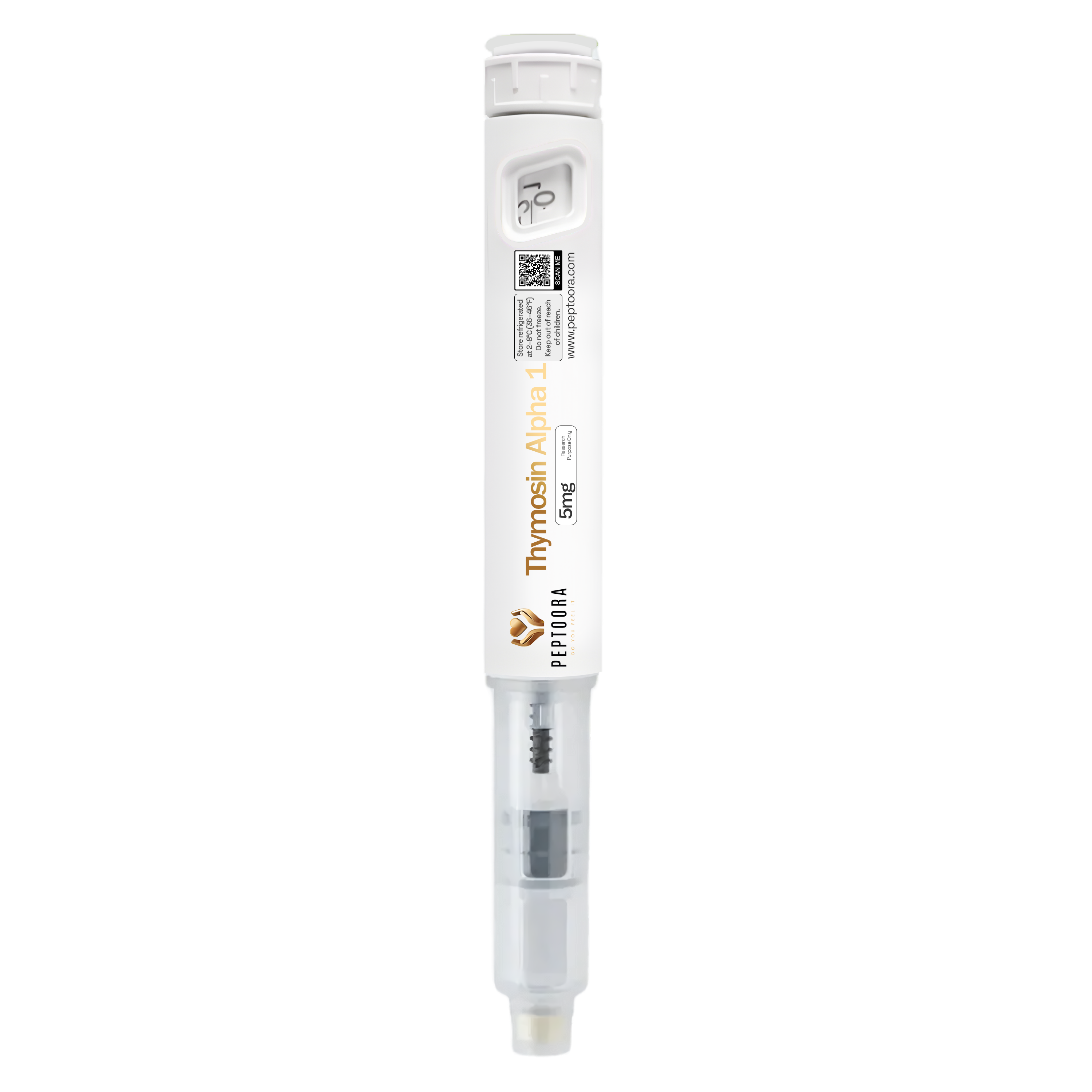
Thymosin Alpha-1 | 30 Mg Pen
Thymosin Alpha 1 (Tα1) is a synthetic thymic peptide (28 amino acids) studied for its role in immune-system coordination across innate and adaptive signaling. In clinical and preclinical research, it has been evaluated in settings where T-cell function, dendritic-cell activity, and interferon-linked antiviral signaling are measured as endpoints. Information on this page is provided for scientific and educational context only and does not represent medical guidance or therapeutic claims.
Supports
- Adaptive immune coordination assessed via T-cell activation and maturation markers.
- Innate immune priming context tracked through dendritic-cell and antigen-presentation readouts.
- Interferon-linked antiviral signaling measured in pathogen-challenge frameworks.
- Cytokine-balance endpoints monitored in immune-stress and inflammation models.
- Immune resilience study designs evaluating host-response normalization under immune suppression.
Description
Thymosin Alpha 1 (Tα1) is a synthetic peptide originally derived from thymic fraction biology and studied as an immunomodulatory signal rather than a direct antimicrobial agent. In experimental immunology, it is frequently used to map how immune cell coordination shifts under infection-like stressors, immune suppression, or inflammatory imbalance—using measurable endpoints such as T-cell subsets, dendritic-cell maturation, cytokine profiles, and interferon-related pathways.
Mechanistic literature commonly frames Tα1 as a regulator of antigen presentation and T-helper polarization, with multiple studies highlighting Toll-like receptor (TLR)-linked signaling context (including TLR9/MyD88) and downstream interferon regulatory factor pathways in dendritic-cell systems. Clinical research has evaluated Tα1 in defined disease settings (for example, viral hepatitis and immune dysfunction in critical illness), but outcomes are cohort- and protocol-dependent.
Tα1 is presented here for controlled research and educational context only. It is not marketed on this page as a universal therapeutic product, and reported observations vary by indication, model, and study design.
Clinical Status
Tα1 has published human clinical research across multiple immune-modulation contexts (including chronic viral hepatitis and immune dysfunction in critical illness), supported by extensive preclinical and in vitro mechanistic work. It has also been approved in select jurisdictions for specific indications (region- and label-dependent). This page does not present any medical-use guidance.
Evidence type:
Human RCT ✔ | Observational ✔ | Animal ✔ | In vitro ✔ | Regulatory approval ✔ (select jurisdictions)
Mechanism of Action
Mechanistic models of Tα1 emphasize immune-cell priming and signaling integration. In dendritic-cell systems, Tα1 has been shown to influence maturation and functional polarization, including pathways linked to TLR9/MyD88 and interferon-regulatory signaling (IRF7) that shape antiviral and Th1-oriented responses. Additional mechanistic work discusses immune-regulatory balancing through pathways associated with antigen presentation efficiency and cytokine expression patterns.
In applied research contexts, these effects are tracked through endpoint panels that include T-cell activation markers (e.g., CD4+/CD8+ dynamics), cytokines (e.g., IL-2, IFN-γ), and innate signaling readouts. Observed effects depend on baseline immune status, challenge model, and protocol timing.
Benefits
-
Enhanced Immune System Coordination:
Thymosin Alpha 1 has been studied for its role in adaptive immune regulation across multiple human and preclinical models. Research suggests it supports communication between innate and adaptive immune compartments. In experimental settings, improved T-cell signaling and dendritic cell activation have been documented. Rather than acting as a blunt immune stimulant, Tα1 appears to modulate immune balance. This regulatory profile makes it relevant in models investigating immune resilience and systemic immune stress. Evidence spans human clinical trials and mechanistic laboratory studies. -
T-Lymphocyte Maturation And Activation:
Clinical trials have shown increased CD4+ and CD8+ T-cell activity following administration in immune-compromised research populations. Enhanced IL-2 receptor expression and improved T-cell proliferation have been observed. In research models, this translates to stronger adaptive immune responsiveness. The peptide appears to influence thymic signaling pathways involved in T-cell differentiation. Laboratory data also indicate improved cytotoxic T-cell function. These findings position Tα1 as a key peptide in T-cell biology research. -
Cytokine Modulation And Inflammatory Balance:
In research models, Thymosin Alpha 1 has been observed to regulate cytokines including IL-2, IFN-γ, and TNF-α. It appears to promote Th1-oriented immune responses while moderating excessive inflammatory cascades. This dual action has been measured through shifts in cytokine expression profiles. Preclinical studies indicate reduced inflammatory signaling in certain immune stress models. The peptide’s regulatory influence is considered distinct from purely pro-inflammatory compounds. Evidence type includes human RCTs and animal models. -
Support For Antiviral Immune Response:
Thymosin Alpha 1 has been evaluated in viral research models where improved immune surveillance was observed. Clinical trials in infectious disease research suggest enhanced interferon signaling and T-cell responsiveness. Laboratory studies indicate activation of Toll-like receptor pathways involved in pathogen recognition. In certain regulatory-approved contexts, Tα1 has been used as an immune adjunct. Other applications remain strictly research-only. The mechanistic basis involves amplification of antiviral signaling cascades. -
Dendritic Cell Activation And Antigen Presentation:
In vitro studies demonstrate increased dendritic cell maturation following exposure to Tα1. Enhanced MHC class I and II expression has been documented. This contributes to improved antigen presentation capacity in experimental immune models. Efficient antigen presentation is essential for adaptive immune memory formation. Research suggests Tα1 may support this process through NF-κB pathway modulation. These findings are primarily derived from laboratory and animal data. -
Oncology-Adjacent Immune Research Applications:
Thymosin Alpha 1 has been studied as an immune adjuvant in oncology-related models. Research suggests enhanced cytotoxic T-cell activity and improved tumor immune recognition in certain experimental settings. It has been evaluated alongside conventional immune-modulating agents in human studies. The mechanistic rationale involves strengthening immune surveillance pathways. While some regulatory approvals exist in specific regions, broader uses remain research-focused. Evidence includes human trials and preclinical tumor models. -
Toll-Like Receptor Pathway Activation:
Technical studies indicate interaction with TLR-2 and TLR-9 receptors. Activation of these receptors leads to downstream NF-κB signaling. This cascade results in increased expression of immune regulatory genes. Laboratory measurements show enhanced interferon production and improved innate immune signaling. This mechanistic pathway is central to its immune-modulating profile. Data are derived primarily from in vitro and animal studies. -
High Bioavailability Through Subcutaneous Administration:
Provided in a stabilized pre-mixed injection pen for SubQ use, supporting consistent experimental dosing. Subcutaneous delivery has been associated with reliable systemic exposure in pharmacokinetic studies. This formulation simplifies research handling compared to multi-step vial reconstitution. Each unit is prepared fresh and formulated for research protocols only. The delivery method supports controlled absorption in experimental models. -
Immune Resilience And Systemic Stress Models:
Research models exploring immune suppression, systemic inflammation, and viral challenge have incorporated Tα1 due to its modulatory profile. Observed effects include improved immune cell coordination and balanced cytokine expression. These outcomes suggest a role in immune resilience research. The peptide does not function as a conventional stimulant but rather as an immune regulator. Evidence spans controlled human studies and mechanistic laboratory experiments.
Research Data
| Study/model | Reported effect |
| Chronic hepatitis B, placebo-controlled RCT (human) | Evaluated virologic/serologic endpoints and clinical markers under defined Tα1 protocols; outcomes were study-dependent. |
| Chronic hepatitis B, systematic review (human RCTs) | Reviewed RCT evidence and reported mixed effectiveness across trials; emphasized uncertainty and heterogeneity across protocols. |
| HBV-related acute-on-chronic liver failure (human study) | Reported improved transplant-free survival endpoints in a defined cohort; proposed infection-related mechanism hypotheses (subgroup-dependent). |
| Sepsis, multicentre phase 3 RCT (TESTS) (human) | Reported no clear evidence of reduced 28-day all-cause mortality; highlighted complexity of sepsis immunomodulation. |
| Sepsis, systematic review & meta-analysis (human RCTs) | Synthesized RCTs; pooled estimates varied and quality limitations were discussed; endpoints often included mortality and immune markers. |
| Dendritic-cell priming via TLR9 signaling (mechanistic) | Demonstrated Tα1 priming of dendritic cells through TLR9/MyD88-linked signaling in antimicrobial resistance frameworks. |
| IDO induction and tolerance/Th1 balance (mechanistic) | Reported Tα1-driven IDO activity in dendritic cells and downstream immune-regulatory effects in model systems. |
| COVID-19 evidence synthesis (human) | Meta-analytic findings reported high heterogeneity and no consistent mortality signal overall; subgroup signals varied by study design. |
Stack Suggestions
In experimental immune-design contexts, Thymosin Alpha 1 is sometimes paired with:
- Thymosin beta-4 / TB-500 (tissue-repair and immune-interface study designs, where relevant)
- Glutathione (redox/immune-stress marker panels)
- NAD+ (bioenergetic + immune resilience endpoints in integrated protocols)
Stacks discussed are for experimental design only, not safety/efficacy guidance.
Possible Side Effects
In clinical research settings, Tα1 is generally described as well-tolerated, with adverse events often limited and context-dependent. This section is provided for general context only and does not constitute medical guidance.
Injection-site reactions: transient redness, swelling, or discomfort can occur.
Headache or fatigue: occasional transient reports in some settings.
Flu-like sensations: occasionally reported in immune-activation contexts.
Sensitivity reactions: rare hypersensitivity-like responses are possible and warrant caution.
Scientific References
- Thymosin alpha1 treatment of chronic hepatitis B — Human RCT
- Thymosin alpha1 for chronic hepatitis B — Systematic review (RCTs)
- Safety and efficacy of Thymosin α1 in HBV-related acute-on-chronic liver failure — Human clinical study
- The efficacy and safety of thymosin α1 for sepsis (TESTS): phase 3 randomized placebo-controlled trial — Human RCT
- Efficacy of thymosin α1 for sepsis: a systematic review and meta-analysis of randomized controlled trials — Meta-analysis
- Thymosin alpha1 activates the TLR9/MyD88/IRF7-dependent pathway in dendritic cells — Mechanistic
- Thymosin alpha1 activates dendritic cell tryptophan catabolism and regulatory programs (IDO) — Mechanistic
- Thymosin-α1 modulates dendritic cell differentiation and functional maturation — In vitro / mechanistic
- Thymosin alpha1 use in adult COVID-19 patients: systematic review and meta-analysis — Meta-analysis
- Mechanism and clinical application of thymosin in the immunomodulatory context — Review
Cautions
- For educational and scientific context only; not intended to diagnose, treat, cure, or prevent any disease.
- If you are pregnant, nursing, have a medical condition, or use prescription medication, consult a qualified professional.
- Discontinue use if sensitivity occurs.
Pairs well with
In stock!
Complimentary shipping & returns
Thymosin Alpha-1 | 30 Mg Pen
FAQs
Read our FAQs page to find more
Do I need a prescription to order?
No prescription is required to order. However, we recommend consulting a healthcare professional before starting any injectable therapy.
How should I store my products?
Store unopened products in a cool, dry place. Refrigerate as instructed after opening.
Are the peptide pens pre-mixed?
Yes. Our peptide pens are pre-mixed and ready to use. They are formulated for convenience and consistent dosing without the need for reconstitution.
Are these products suitable for everyone?
These products are intended for responsible adult use. Individual suitability varies depending on medical history, medications, and overall health status. Consulting a qualified medical professional before use is essential.
Are these products intended for medical treatment?
These products are not intended to diagnose, treat, cure, or prevent any disease. They are offered within the scope of applicable regulations and should be used responsibly.
If you have any questions, you are always welcome to contact us. We'll get back to you as soon as possible, within 24 hours on weekdays.
-
Shipping Information
Use this text to answer questions in as much detail as possible for your customers.
-
Customer Support
Use this text to answer questions in as much detail as possible for your customers.
-
FAQ’s
Use this text to answer questions in as much detail as possible for your customers.
-
Contact Us
Use this text to answer questions in as much detail as possible for your customers.